

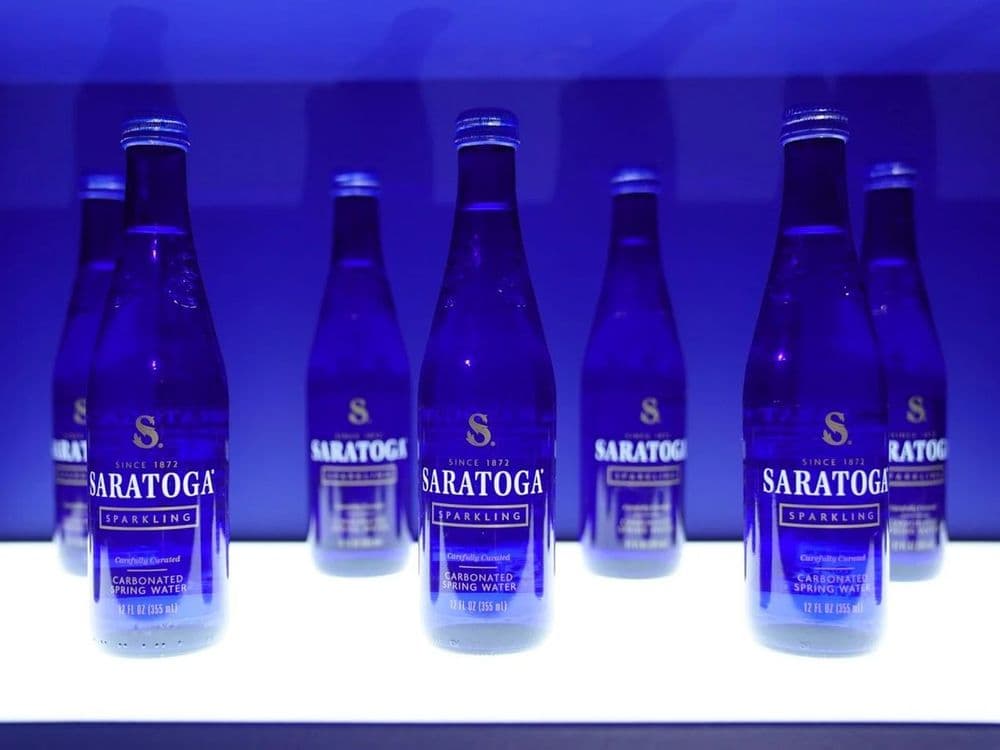
Saratoga Spring Water Lab Results
Independent testing detected 9 contaminants in Saratoga spring water.
Key Takeaways
- Independent lab testing detected 9 contaminants in Saratoga’s “Spring Water Glass Bottle.”
- Total Trihalomethanes (TTHMs) measured up to 7× higher than a health-based guideline.
- Disinfection byproducts in “spring water” are a Best Signal of treatment or blending.
- Saratoga now lists multiple spring sources, reducing batch-level traceability.
- Watershed stress and multi-site sourcing can increase water variability over time.
Buyer Checklist
- Treat TTHMs in “spring water” as a Best Signal of disinfection or blending.
- Look for clear, single-source transparency rather than vague multi-site language.
- Prefer brands that publish consistent, recent lab results.
- Do not assume glass packaging guarantees purity or stable sourcing.
- Re-check ratings periodically because sourcing can change quietly.
What Happened to Saratoga Spring Water?
Saratoga has long been marketed as premium spring water: naturally filtered, glass bottled, and low in contaminants.
Recent independent testing suggests a different profile.
What We Found in Lab Testing
Our latest lab analysis detected 9 contaminants in Saratoga’s “Spring Water Glass Bottle.”
This batch scored 43/100 (Poor).
Disinfection Byproducts
These compounds should not appear in genuinely untreated spring water.
- Total Trihalomethanes (TTHMs): 0.0011 mg/L (7× health guideline)
- Chloroform: 0.0009 mg/L (2× health guideline)
TTHMs form when disinfectants react with organic matter.
Their presence is a Best Signal that disinfection has occurred.
Chloroform is one component of TTHMs.
It reinforces the same signal.
Heavy Metals and Industrial-Linked Contaminants
Some of these metals can occur naturally.
They can also reflect watershed stress or industrial influence.
- Nitrate (as NO₃⁻): 0.71 mg/L (1× limit)
- Chromium: 0.0006 mg/L (1× limit)
- Cadmium: Detected (flagged with 5 risks)
- Nickel: 0.0008 mg/L
- Uranium: 0.00008 pCi/L (below limit but notable)
- Barium: 0.01 mg/L
Nitrate is often associated with agricultural runoff, sewage influence, or decaying organic matter.
Cadmium is a toxic heavy metal that can accumulate in the body over time.
Fluoride
Fluoride was detected at a low level.
It is not the primary concern in this report.
- Fluoride: 0.2 mg/L (below limit)
Its presence can still align with treated water influence.
Minerals and Variable Source Fingerprints
These minerals are not inherently harmful at the listed levels.
The overall pattern can suggest variability across sources.
- Silica: 7.39 mg/L
- Chloride: 8.32 mg/L
- Calcium: 8.05 mg/L
- Magnesium: 1.29 mg/L
- Potassium: 0.39 mg/L
- Sodium: 2.34 mg/L
- Molybdenum, Phosphorus, Strontium: Trace levels
This profile looks less like a single, stable spring.
It looks more like water that may vary depending on sourcing.
Saratoga Spring Water Source Disclosure
Saratoga now lists multiple spring locations.
Examples include:
- White Cedar Spring (ME)
- Dallas Plantation (ME)
- Greenwaltz Spring (PA)
- Nature’s Way Springs (PA)
Multi-site sourcing reduces traceability.
Bottles do not specify which source filled a given batch.
Environmental Changes That Can Shift Spring Water Quality
Saratoga historically benefited from hydrology tied to the Adirondack foothills.
Recent watershed reporting in the Saratoga Springs area, including Loughberry Lake, describes measurable ecological decline.
Reported changes include:
- 7% reduction in usable lake capacity
- 22% decline in safe yield
- Rising pH and alkalinity
- Increases in nitrogen, phosphorus, and chlorophyll
- More contamination from pesticides, road salts, sediment runoff, and development
These are common stress signals in surface water systems.
When nutrient loads and organic matter rise, disinfectants are more likely to form byproducts like TTHMs.
How Corporate Sourcing Can Change a “Single Source” Brand
In 2021–2022, BlueTriton Brands acquired Saratoga Spring Water.
After the acquisition, the brand shifted from a single-source identity toward multi-site sourcing.
Large portfolios often manage supply this way.
Common quality implications include:
- Spring variability: Each source has a different contaminant and mineral profile.
- Seasonal mixing: Blending can increase when output drops or demand spikes.
- Municipal supplementation: Treated water can be used if spring supply is limited.
- Reduced traceability: Consumers cannot see which source is in the bottle.
When sourcing becomes flexible, quality can change without clear labeling updates.
Why TTHMs in Bottled Spring Water Are a Red Flag
TTHMs typically form after chlorination.
They do not typically form in untreated spring water.
They form when chlorine reacts with:
- Organic matter
- Decaying vegetation
- Agricultural and soil runoff
- Elevated nutrients such as nitrogen and phosphorus
Long-term exposure concerns discussed by public health and toxicology sources include:
- Bladder cancer
- Increased miscarriage risk
- Low birth weight
- Liver and kidney stress
- DNA damage
The EWG health guideline for TTHMs is 0.15 ppb.
It is based on a one-in-one-million lifetime cancer risk.
The EPA limit is 80 ppb.
It is Legally Required, but it is often criticized as outdated relative to health-based targets.
If a “natural spring water” contains TTHMs, it is a strong indicator of disinfection, blending, or treated water influence.
That is why TTHMs are a Best Signal issue rather than a minor trace impurity.
What This Means for Saratoga Buyers
Saratoga’s profile appears to have shifted from its earlier single-source positioning.
The shift may relate to watershed stress, multi-source sourcing, and increased variability.
Contributing factors discussed in this draft include:
- Watershed stress reducing dependable untreated supply
- Multi-source sourcing lowering batch-level transparency
- Blending and treatment increasing variability and byproduct formation
Together, these factors help explain a 43/100 score.
They also help explain why 9 contaminants appeared in recent testing.
Why Continuous Testing Matters
Brands evolve over time.
Sourcing, ownership, and supply strategy can change what ends up in the bottle.
Reputation alone Does Not Guarantee current quality.
Ongoing, independent testing is the clearest way to track what consumers are actually drinking.
Check the latest on bottled water
Find the healthiest bottled water ranked and reviewed using the latest lab data, toxicology, and environmental health research.
References
Times Union — Report: Saratoga Springs drinking water source
BlueTriton Brands — BlueTriton Brands Completes Acquisition of Saratoga Spring Water Company (PDF)
EWG Tap Water Database — Total Trihalomethanes (TTHMs)
Florida Department of Health — Total Trihalomethanes (THMs) Fact Sheet (2017)
SoftPro Water Systems — Total Trihalomethanes (TTHMs): Tap Water Contaminant Health Risks