

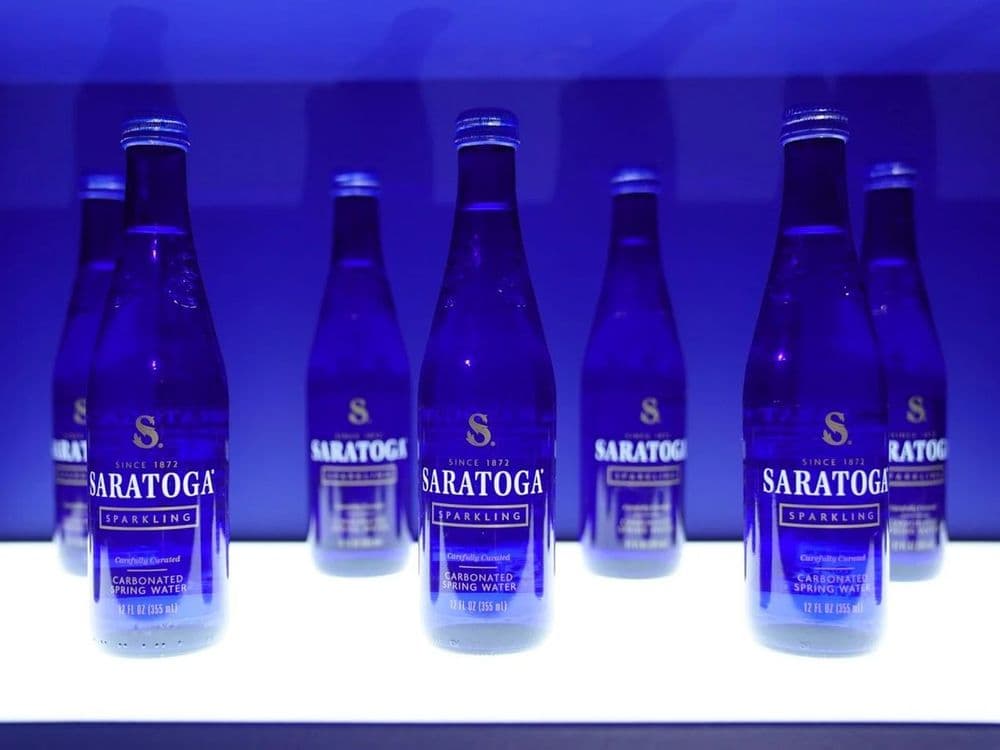
Saratoga Spring Water Lab Results
Independent testing detected 9 contaminants in Saratoga Spring Water.
Saratoga spring water is often marketed as pure, natural, and sourced from protected springs, but recent lab testing shows the presence of disinfection byproducts like TTHMs and chloroform. These compounds are typically linked to treated water systems, not untouched spring sources, which raises valid questions about how the water is sourced or handled.
The findings point to a meaningful signal, not a complete explanation. They suggest possible treatment, blending, or sourcing variability, but they do not prove exactly how every batch is produced. This distinction matters because the brand now lists multiple spring sources, which makes consistency harder to verify.
What Happened to Saratoga Spring Water?
Saratoga has long positioned itself as premium spring water with natural filtration and glass packaging. Recent lab results suggest the composition is more complex than that original framing.
Brand reputation can persist even as sourcing or operations change. Reputation alone Does Not Guarantee that the current product matches past expectations.
What We Found in Lab Testing
Independent testing identified 9 contaminants in the sampled batch, with an overall score of 43 out of 100. This placed it in the Poor category compared to other bottled waters.
The most important finding was not packaging or branding. It was the presence of compounds commonly associated with treated water systems.
- Total contaminants detected: 9
- Overall score: 43 out of 100
- Category: Poor relative ranking
Why TTHMs Matter in Saratoga Spring Water
Total trihalomethanes form when disinfectants like chlorine react with organic material. They are typically measured in municipal systems, not in untreated spring water.
- Total TTHMs: 1.1 ppb
- Chloroform: 0.9 ppb
These levels are below the EPA Legally Required limit of 80 ppb. They are above the Environmental Working Group health guideline of 0.15 ppb, which is based on long term cancer risk modeling.
This is why TTHMs are a Best Signal. They do not confirm the exact source or process, but they strongly suggest treatment, blending, or indirect exposure to treated supply.
Disinfection Byproducts Detected
Two related compounds appeared together, which strengthens the interpretation.
- Total Trihalomethanes: 0.0011 mg/L
- Chloroform: 0.0009 mg/L
Chloroform is part of the TTHM group, so seeing both together points toward a treatment-related fingerprint rather than natural mineral variation.
Heavy Metals and Other Contaminants Detected
Contaminants can come from geology, runoff, or watershed conditions. The pattern across multiple readings is more informative than any single number.
Detected compounds included:
- Nitrate: 0.71 mg/L
- Chromium: 0.0006 mg/L
- Cadmium: detected
- Nickel: 0.0008 mg/L
- Uranium: 0.00008 pCi/L
- Barium: 0.01 mg/L
- Fluoride: 0.2 mg/L
Nitrate is often linked to agricultural runoff or organic decay. Cadmium stands out due to its toxicity and tendency to accumulate in the body over time.
None of these values alone defines the source. Together, they suggest variability that may not align with a tightly controlled single spring.
Minerals and Source Variability
Minerals are expected in spring water, but their balance can reveal whether sourcing is consistent.
Reported levels included:
- Silica: 7.39 mg/L
- Chloride: 8.32 mg/L
- Calcium: 8.05 mg/L
- Magnesium: 1.29 mg/L
- Potassium: 0.39 mg/L
- Sodium: 2.34 mg/L
These levels are not harmful. The key issue is whether the profile reflects one stable source or multiple sources over time.
Saratoga’s Source Disclosure Has Changed
The brand now lists multiple spring locations instead of a single origin. Named sources include locations in Maine and Pennsylvania.
This reduces traceability. Buyers can see possible origins, but not which source filled a specific bottle.
The Default Assumption for premium spring water is a consistent single source. That assumption becomes harder to support with multi-site sourcing.
How Watershed Conditions Can Affect Water Quality
Spring systems are influenced by environmental changes in surrounding areas. Land use, runoff, and nutrient levels can alter water chemistry over time.
Reported conditions in the Saratoga watershed include:
- Reduced usable lake capacity
- Declines in safe yield
- Increased nitrogen and phosphorus
- Rising pH and alkalinity
Higher organic content increases the chance of disinfection byproduct formation if treatment is applied. This does not prove causation, but it provides a plausible pathway.
How Ownership Changes Can Affect Water Quality
Saratoga was acquired by BlueTriton Brands between 2021 and 2022. After this transition, sourcing expanded beyond a single identity.
Operational shifts like this can introduce:
- Variability in contaminant profiles
- Seasonal changes in composition
- Increased likelihood of blending
- Reduced batch-level transparency
Branding can remain stable while sourcing becomes more flexible.
Why Glass Packaging Can Be Misleading
Glass is often associated with purity and quality. It can reduce some packaging concerns, but it does not reflect sourcing or treatment practices.
What To Check is not the packaging first. It is the source disclosure, contaminant data, and whether recent testing aligns with expectations.
What This Means for Saratoga Buyers
The current data suggests a more variable profile than a traditional single-source spring water. The combination of TTHMs, multi-source disclosure, and contaminant diversity is the key signal.
Three practical interpretations:
- Some batches may involve treatment or blending
- Multi-source sourcing may reduce consistency
- Environmental factors may be increasing variability
These findings do not apply equally to every bottle. They do indicate that buyers should rely on current data rather than legacy reputation.
Why Continuous Testing Matters
Bottled water quality can change over time. Ownership, sourcing, and environmental conditions all evolve.
Independent testing provides a clearer snapshot than marketing language. Reputation alone Does Not Guarantee current quality when transparency decreases.
The practical takeaway is simple. Even premium spring water in glass can show signs of treatment or sourcing drift, and repeat testing is the only reliable way to track it.
Buyer Checklist
- Treat TTHMs in spring water as a Best Signal of disinfection or blending
- Look for clear single-source transparency instead of vague multi-site sourcing
- Prefer brands that publish consistent and recent lab results
- Do not assume glass packaging guarantees purity or stable sourcing
- Re-check ratings periodically because sourcing can change quietly
Check the latest on bottled water
Find the healthiest bottled water ranked and reviewed using the latest lab data, toxicology, and environmental health research.
References
Times Union - Report Saratoga Springs drinking water source
BlueTriton Brands - BlueTriton Brands Completes Acquisition of Saratoga Spring Water Company
EWG - Total Trihalomethanes Overview