

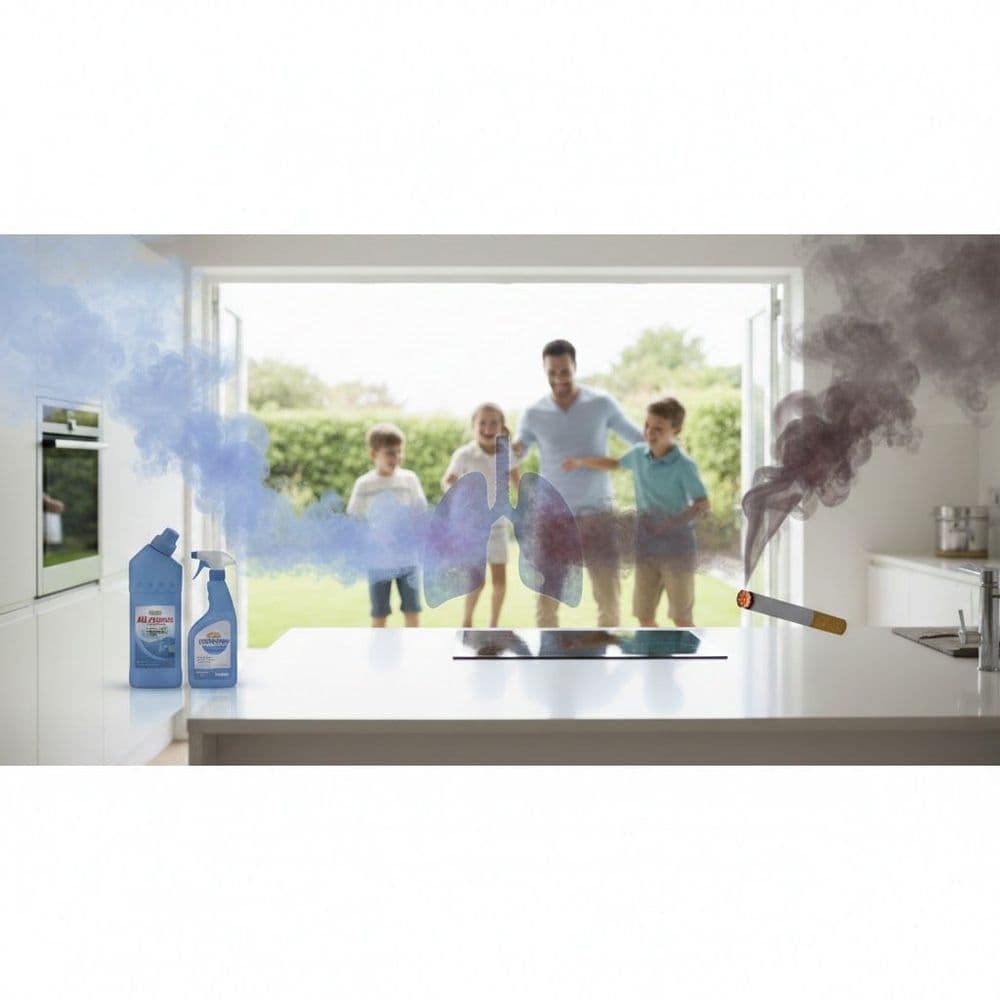
Cleaning Chemicals Can Harm Your Lungs Like Smoking
Regular exposure to cleaning sprays is linked to lung damage similar to smoking
Cleaning products are often framed as protective, but the exposure pathway is what changes the risk profile. Sprays and aerosols convert liquids into fine particles that stay suspended in air and reach deep into lung tissue.
The research points to a consistent signal rather than definitive proof of harm in every case. Long-term observational data suggests repeated inhalation may accelerate lung function decline, especially with spray use, but it does not guarantee the same outcome for every individual or product.
Buyer Checklist
- Avoid spray and aerosol cleaning products whenever possible
- Choose fragrance-free and low-VOC formulations
- Use liquids, wipes, or solids instead of airborne cleaners
- Clean in well-ventilated areas or open windows during use
- Limit unnecessary disinfectant use in low-risk settings
Do Cleaning Products Damage Your Lungs?
Cleaning products are often associated with hygiene and health. Evidence now shows that repeated exposure to certain chemicals can impair lung function over time.
This is not limited to industrial settings. It occurs during routine home cleaning.
What Studies Say About Lung Function Decline
A large prospective cohort study followed more than 6,000 adults over 20 years. Researchers tracked lung function using forced expiratory volume (FEV1) and forced vital capacity (FVC).
Key findings include:
- Women using cleaning sprays weekly experienced an additional FEV1 decline of about 3.6 mL per year
- Professional cleaners showed declines closer to 3.9 mL per year
- The magnitude of decline was comparable to long-term smoking exposure in some groups
This was an observational study. It cannot prove causation, but the consistency and biological plausibility strengthen the concern.
Why Spray Cleaning Products Increase Risk
The main issue is inhalation exposure. Sprays transform liquid chemicals into airborne particles.
These particles:
- Remain suspended in indoor air for extended periods
- Are small enough to reach deep lung tissue
- Bypass upper airway defenses like nasal filtering
- Increase total exposure compared to direct surface application
Once inhaled, they can trigger irritation and immune responses that accumulate over time.
How Lung Damage Develops Over Time
Repeated exposure to irritants can gradually alter lung structure and function. These changes build slowly and often go unnoticed at first.
This process may include:
- Chronic inflammation of airway tissue
- Thickening of airway walls
- Reduced elasticity of lung tissue
- Impaired airflow efficiency
Symptoms often appear only after measurable damage has occurred.
Chemicals Linked to Respiratory Effects
Many common cleaning ingredients are known airway irritants when inhaled repeatedly. Some are also associated with occupational asthma in high exposure settings.
Examples include:
- Ammonia, which irritates mucous membranes and inflames airways
- Chlorine-releasing agents, which can form reactive gases
- Quaternary ammonium compounds, linked to airway sensitization
- Synthetic fragrances, which release complex volatile mixtures
- Volatile organic compounds that degrade indoor air quality
Controlled exposure studies show even short-term exposure to chlorine-based cleaners can reduce lung function within hours.
Who Is Most at Risk
Risk increases with frequency and intensity of exposure. The cumulative dose over time is a key driver.
Higher-risk groups include:
- People who clean frequently using sprays
- Professional cleaners with daily exposure
- Individuals with asthma or allergies
- Children exposed to indoor aerosols
Population data suggests women show greater long-term decline, likely due to higher exposure patterns rather than inherent biological differences.
Why Symptoms Often Appear Late
Cleaning-related lung damage develops gradually. Early effects are subtle and often overlooked.
Common patterns include:
- Mild irritation mistaken for seasonal allergies
- Slow decline attributed to aging
- Lack of noticeable symptoms until later stages
- Detection only through lung function testing
By the time symptoms become obvious, structural changes may already be present.
Long-Term Health Implications
Chronic exposure to respiratory irritants is linked to several conditions. The risk depends on duration, concentration, and individual sensitivity.
These include:
- Asthma development or worsening
- Chronic obstructive pulmonary disease
- Reduced exercise capacity
- Persistent cough and airway sensitivity
Indoor air quality plays a major role in long-term respiratory health. In many cases, indoor exposure rivals or exceeds outdoor pollution.
Practical Ways to Reduce Exposure
You do not need to stop cleaning. Reducing inhalation exposure is the most effective step.
Effective strategies include:
- Avoiding sprays and aerosols entirely
- Using liquids or wipes applied directly to surfaces
- Improving ventilation with open windows or fans
- Choosing fragrance-free formulations
- Limiting disinfectant use to necessary situations
Small adjustments can significantly lower the amount of airborne chemicals you inhale.
Why Indoor Air Quality Matters
People spend most of their time indoors. This makes indoor air a primary driver of cumulative exposure.
Cleaning products contribute to indoor pollution through:
- Direct chemical emissions
- Airborne particle generation
- Reactions that create secondary pollutants
Protecting lung health requires attention to indoor environments, not just outdoor air.
The Bottom Line
Cleaning products are designed to support hygiene. Certain forms, especially sprays, can undermine respiratory health when used frequently.
Understanding how exposure happens allows for simple, effective changes that protect long-term lung function.
Check the latest on cleaning products
Find the healthiest cleaning products ranked and reviewed using the latest lab data, toxicology, and environmental health research.
References
European Respiratory Society — Cleaning products and respiratory health
ERS Monograph — Airway Response to Irritants and Chemical Exposures